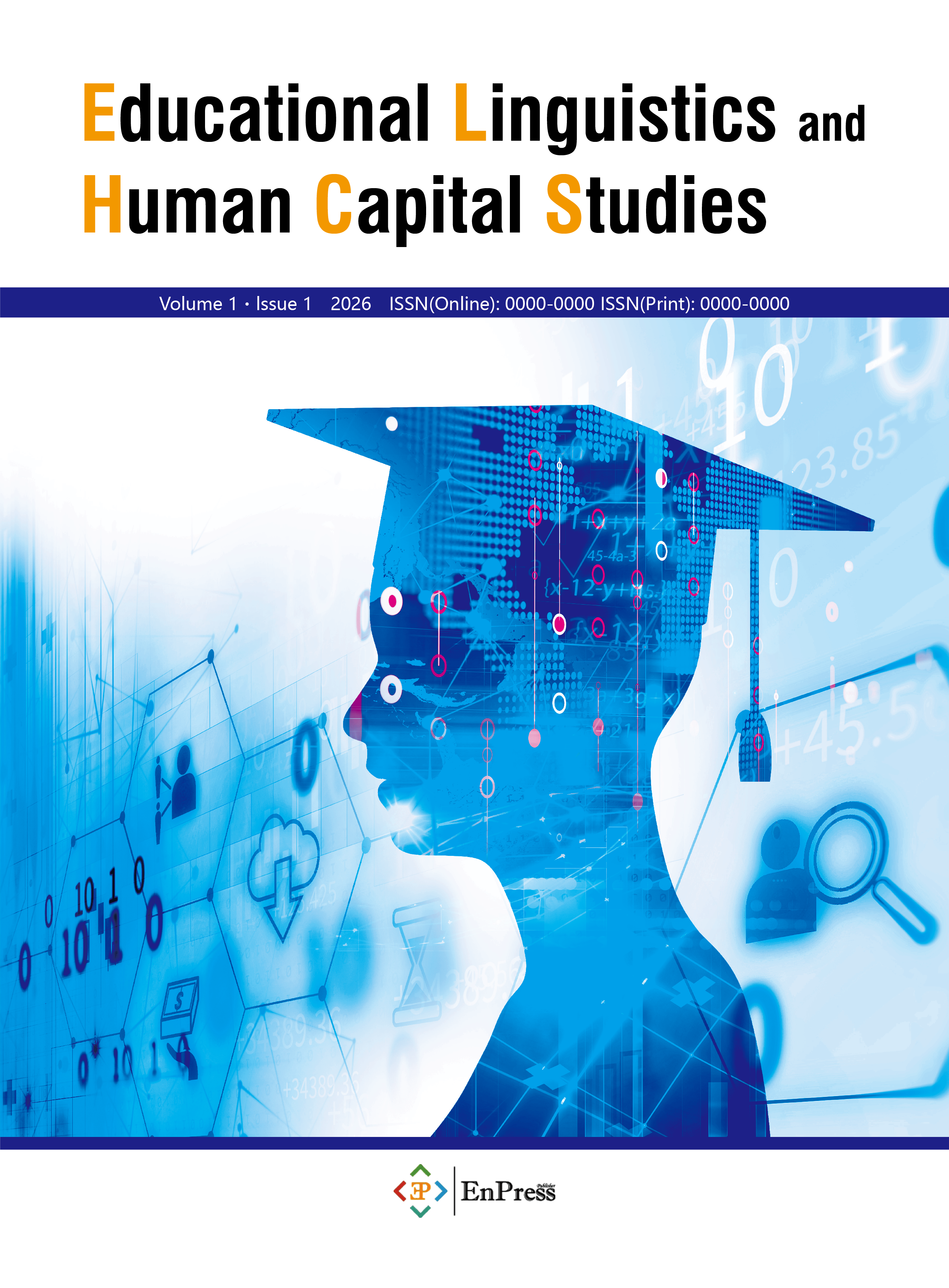
The Editorial Office is pleased to announce the official launch of Educational Linguistics and Human Capital Studies (ELHCS), an international peer-reviewed academic journal dedicated to advancing interdisciplinary scholarship at the intersection of educational linguistics, language education, human capital development, workforce transformation, and socio-economic advancement.
Language has long been recognized as a fundamental means of communication, learning, and social interaction. Yet in contemporary knowledge-based economies, language competence has become much more than a communicative skill. Linguistic abilities—including native-language proficiency, multilingual competence, intercultural communication skills, academic literacy, and emerging digital language capabilities—have become increasingly valuable forms of human capital that influence educational attainment, employability, professional development, income generation, and social mobility.
As globalization, technological innovation, and digital transformation continue to reshape societies and labor markets, language-related competencies are assuming a growing role in determining individual and organizational success. Educational institutions are expected to cultivate communication skills that meet evolving workforce demands, while employers increasingly seek professionals capable of operating across linguistic, cultural, and technological boundaries.
Despite these developments, research on language, education, and human capital often remains fragmented across disciplinary fields. Educational linguistics primarily focuses on language learning and teaching; labor economics examines workforce productivity and returns to education; human resource management studies talent development and organizational performance. However, the complex relationships among language competence, human capital formation, labor-market outcomes, and socio-economic development remain insufficiently integrated within existing scholarship.
ELHCS was established to address this gap. The journal seeks to provide a dedicated platform for exploring how language education, linguistic competencies, and communication skills contribute to human capital development and shape opportunities in an increasingly interconnected and technology-driven world.
The mission of ELHCS is to promote high-quality, evidence-based, and policy-relevant research that:
Examines the relationships among language education, linguistic competence, human capital formation, and workforce development;
Investigates the economic, organizational, and social returns to language-related skills and competencies;
Explores the role of language in employability, productivity, leadership development, and international talent mobility;
Addresses contemporary challenges associated with multilingualism, migration, digital transformation, and changing labor-market demands;
Advances innovative approaches to measuring and evaluating linguistic capital and workforce capabilities;
Encourages interdisciplinary collaboration across educational linguistics, economics, human resource management, sociology, public policy, and related fields;
Strengthens the connection between academic research, educational practice, and workforce policy.
ELHCS is committed to maintaining the highest standards of academic integrity, transparency, and scholarly rigor. All submissions undergo a rigorous double-anonymized peer-review process conducted by experts from relevant disciplines.
The journal welcomes contributions from scholars, educators, economists, human resource professionals, policymakers, and practitioners worldwide. We are dedicated to fostering an open, inclusive, and intellectually vibrant platform that promotes interdisciplinary dialogue and advances research with both theoretical significance and practical impact.
Particular emphasis is placed on studies that provide evidence-based insights into how language competencies influence educational success, workforce participation, organizational effectiveness, economic opportunity, and long-term human development.
As societies become increasingly interconnected and labor markets continue to evolve, language competencies are emerging as one of the most important and dynamic forms of human capital. Understanding the relationship between language, education, work, and economic development is therefore essential for individuals, organizations, and policymakers alike.
Through ELHCS, we seek to build a global scholarly community dedicated to advancing research on language, human capital, and the future of education and work.
We warmly invite researchers, educators, policymakers, employers, and practitioners from around the world to join this new academic endeavor and contribute to the advancement of educational linguistics and human capital studies.

Copyright © by EnPress Publisher. All rights reserved.