







-
Dec 23, 2019Meet our Editors-in-Chief


Prof. Dmitry Ponomarev Prof. Leonor Calv
St. Petersburg Forest Technical University, Russian Federation University of León, Spain -
Jun 30, 2019SF Volume 2, Issue 1 is now live!
We are pleased to announce that the Vol. 2, Issue 1 for 2019 of Sustainable Forest has been published, and is currently available for download.
Click here to access the full issue.
-
Jan 2, 2019Call for papers
Aims & Scope
Sustainable Forestry (SF, eISSN: 2578-2002) is an open access, peer-reviewed journal publishing scientific research from any discipline that can provide interesting contributions about forest ecosystems and their sustainability. Innovative science as well as application-oriented work is welcomed. They could cover a broad spectrum of forest sciences including genetics, physiology, ecology, hydrology, meteorology, agroforestry, forest economics and policy, etc., all in relation to benign development of forest.
-
Sept 15, 2018Warming: Peatlands will store more carbon initially, but that will changePeatlands are extremely effective at storing carbon, but an international study featuring a University of Queensland researcher has found climate change could stop that.
The group investigated how peatlands -- swamps and bogs with organic rich soils -- have responded to climate variability between 850 BCE and 1850 CE.
Associate Professor Patrick Moss, from UQ's School of Earth and Environmental Sciences, believes the research is critical in understanding how climate affects the absorption properties of peatlands.
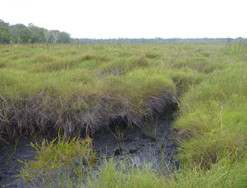 These are the peatlands of Moon Point on Queensland's Fraser Island.Credit: Patrick Moss
 -
Sept 8, 2018In warming Arctic, major rivers show surprising changes in carbon chemistryOver the past several decades, the Arctic has begun to show signs of significant ecological upheaval. The rate of warming in the Arctic is nearly twice the global average, and those changes are triggering a cascade of destabilizing environmental effects. Ice is melting, permafrost is thawing, and experts say fires in Arctic forests are as damaging as they've been in 10,000 years.
But new research suggests that the same factors driving the Arctic's changing climate are fueling a geological response that could play a small part in counteracting those changes' malign effects.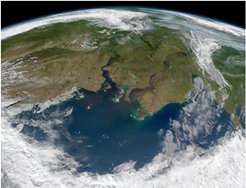 In two major arctic rivers, a changing climate and shifting human activities are having a surprising response.Credit: Norman Kuring, NASA
 -
Aug 23, 2018Carbon reserves in Central American soils still affected by ancient Mayan deforestationDeforestation is suspected to have contributed to the mysterious collapse of Mayan civilization more than 1,000 years ago. A new study shows that the forest-clearing also decimated carbon reservoirs in the tropical soils of the Yucatan peninsula region long after ancient cities were abandoned and the forests grew back.
The findings, published in the journal Nature Geoscience, underscore how important soils and our treatment of them could be in determining future levels of greenhouse gases in the planet's atmosphere.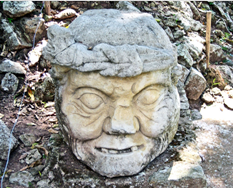 This is an ancient stone carving of the Maya God Pauahtun, taken at Copan Ruinas, Honduras.Credit: Peter Douglas


